
Blackburn Cotton Exchange – A New Re:Source
Posted by Roving Mick on February 1, 2016
Just over a year ago, my monthly blog was about our derelict Cotton Exchange and a call for something to be done about bringing it back into use.
We’re talking about one of Blackburn’s few historical and aesthetically pleasing buildings here. It was slowly heading for inevitable destruction. Many of its windows are broken, leading to pigeons and other wildlife already taking up residence in the building. No doubt rough sleepers will have found their way inside too. This could lead to fires, flooding and more destruction to the building.
But amidst all these dark clouds hanging over our old cinema, sunshine is peeping through those broken windows. Re:Source Blackburn is a charity who come from a Christian background. They bought the building last September, thanks to a loan, various donations and a grant from the council. Further funding is also being looked at.
Re:Source plans include turning the building into a business centre, with boardroom, conference and restaurant facilities. A Creativity Centre is also being considered. This could put on exhibitions, host concerts and even take the building back to one of its former uses by showing films. They expect to spend around £5M on renovations and refurbishments.
My article in January 2015 was written out of frustration over the state of our old Cotton Exchange. Little did I know plans were afoot to purchase it and bring it back to its former glory. But highlighting the issue on my website may have got some people talking about it and keeping the issue alive.
What I found out after publishing my article a year ago was how much popular feeling the old Cotton Exchange still engenders in Blackburn and beyond. Whether it was happy days in front of the silver screen, or just the sheer admiration of this beautiful structure, many of us remember having good times there.
Even in today’s present dilapidated state, many fellow Blackburners would love to see the building restored and become the hub of activity it was in days gone by. Hopefully those hopes look like they could come to fruition in the next few years.
Blackburn’s Sleeping Policemen Give Us The Hump
Posted by Roving Mick on January 2, 2016
Ask any bus or taxi driver what part of their job they really hate. They will tell you about their backs being done in due to driving over sleeping policemen and other road humps.

They give us the Hump
I know how they feel from personal experience; my street has a school nearby. So sleeping policemen are crashed out every few yards, including right outside my front door. They are described as traffic calming measures. But few people would describe themselves as calm after going over them on a dark night, especially while dropping off in the back seat of a taxi.
Blackburn’s worst areas for speed humps seem to be Revidge, Highercroft and Shadsworth. A bus ride up Highercroft is like going up and down a roller coaster. Things are not helped by the twists and turns the buses have to take along their route, no thanks to bad parking.
Shadworth’s assault course is more direct, travelling along Rothesay Road. But it’s not only humps which impede the flow of traffic. Speed cushions are also in use here. Those annoying twisting single file chicanes also add to a road user’s misery.
On the other side of town, Wimberley Street has a particularly difficult chicane to navigate, not helped by parked cars. Here one marvels at the skills of the bus driver in action. Sadly, some of the car parking here leaves a lot to be desired.
Pride of place for sleeping policemen must belong to the north side of Blackburn’s infamous Revidge Hump, where you pass the Golf Club. Despite warning signs, this tarmac obstacle seems to catch everybody out. You can sometimes see evidence in the road of this, where dumper trucks have shed part of their load after misjudging the hump.
Unfortunately, sleeping policemen and other traffic calming measures are there for a reason. The drivers who wouldn’t slow down are the reason why they exist in the first place. Sadly, they also add extra time to the fire engines, ambulances and wide-awake policemen’s response times.
These emergency services are often sent to save the victims of accidents caused by those unreasonable drivers whose actions merited traffic calming measures being brought in. But if the humps were taken away, you can guarantee somebody would be complaining within 24 hours about traffic going too fast down the street. Whatever happens with sleeping policemen – somebody’s going to get the hump.
Blackburn Mall Has A Lot To Weigh Up
Posted by Roving Mick on December 8, 2015
There seem to be a lot of places where you can buy a meal in and around Blackburn Mall these days. Some sell good quality food, but the fast food outlets are also there.

They always seem to want to shove another culture on us, mainly the American way of life we see right across the broadcast media. They advertise themselves with cardboard cut-outs and star-spangled signs. Their unfortunate staff often have to wear baseball caps with a hole at the back where pony tails can be tucked through. These staff also have to say banal things to you like: ‘You got it’, or ‘Have a nice day’. What these fast food places don’t want you to know is how bad the American way of life can be for some people’s health.
I used to work in Blackburn town centre for the local council. My colleagues and I used to be continuously blitzed with interfering lifestyle propaganda. Posters were emblazoned on walls, even in the toilets, telling us to give up smoking, give up drinking at certain times, walk to work and even go on organised walks at dinnertime.
But we never received any emails or leaflets telling us to stop eating junk food. So it was all right to put at risk the jobs of workers in the brewery and nearby pubs and clubs by giving up drinking, even in moderation. But those fast food eateries and takeaways were never discouraged.
Sadly, nobody can deny Blackburn is one of the most deprived towns in the country. And this makes it a good example of where more of these fast food places seem to be opening up. No doubt our council is grateful to these new tenants taking up valuable space in our shopping Mall and people do have the right to be treated like adults and eat what they want – unless they are children of course. Here it seems to be open season on dragging them in by any means possible, with billions of pounds and dollars of advertising budgets. You don’t have to look so far to see what good value this advertising has yielded.
But our local politicians’ Westminster colleagues on the Parliamentary Health Select Committee are calling for fast food outlets to be banned from hospitals. They are also calling on local councils to get powers to limit the proliferation of fast food outlets in certain areas. Looks like their pleas may have fallen on deaf ears in Blackburn.
For the record, my favourite place for a good wholesome meal is underneath the Mall, in the Market and it’s called The Carvery. Amongst other nice food, they make a really good beef stew and dumplings and sell tasty fruit pies.
Quarryman’s Saved By The Girl Next Door
Posted by Roving Mick on November 1, 2015

Upon this Rock
The Quarryman’s pub may have the distinction of being Blackburn’s smallest pub. It might now even be its highest above sea level, although they might disagree in the Black Bull and the three pubs up Haslingden Road.
What should be agreed upon is how well the ‘Quarry’ has done to survive at all, where others in its local area have not. In some cases, it has been no thanks to Daniel Thwaites and their restrictive covenant obsession. So this little pub and the Alexandra, just down Dukes Brow, are all that is left of Blackburn’s ‘Revidge Run’. This was the surrounding area of a triangle made up of Revidge Road, Dukes Brow and Preston New Road. There used to be nine pubs, including the nearby Corporation Park and Woodlands. But now only two remain.
Make no mistake; the Quarryman’s has had its problems over the years too, even allegedly being haunted by a ghost called Albert. He is said to have been an unlucky victim of an accident with a beer barrel in the pub’s cellar. Unfortunately the only spirits I’ve ever seen in here are called rum, whisky and vodka.
But still being open as a pub is no mean feat these days. The Quarryman’s even had its name changed to the Duck and Puddle for a time. Thankfully this didn’t last and it reverted back to its proper name, reflecting this area’s quarrying tradition. Hopefully its life as a pub will be prolonged by the arrival of Rebecca – the girl next door.
Becky and her partner actually do live in the property next door, which makes up half of the same building. She has a good pedigree in Blackburn’s local pub trade. Her mother used to have the Hare and Hounds on the other side of the hill. Becky also has experience of working in the Red Lion, Holehouse and Griffin. Becky and her partner moved next door to the Quarryman’s in May. Her partner works full-time, which means, as a couple with a young family, they are not dependant on income from the pub.
On my first visit it was good to see Holt’s cask ale was still available and in good condition. Hopefully, this should encourage Blackburn’s CAMRA members and real ale drinkers to pay the pub a visit. There is even a bus stop right across the road. The No.9 Revidge bus runs past the pub from town every hour until 5.55pm. On weekdays the pub opens at 3.00pm and at twelve on Saturdays and Sundays.
Skimmy Southworth – Rovers’ Musical Goal Machine
Posted by Roving Mick on October 1, 2015
Who was Blackburn Rovers’ greatest goalscorer? Was it Shearer, Sutton, Tommy Briggs, Simon Garner, or present day poacher, Jordan Rhodes?
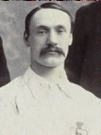
Skimmy knew how to blow his own trumpet
Believe it or not, one former player, actually born and bred in Blackburn, is up there with the best of them when it comes to his record of scoring goals for Rovers. His strike rate is even higher than Alan Shearer’s!
Jack Southworth was born on Ainsworth Street in 1866 and baptised in what became Blackburn Cathedral. He came from a musical family and would go on to become a professional musician when his football career was ended by injury.
His brother Jim, also a musician, played alongside his sibling for Rovers. Both of them started playing with Rovers’ town rivals, Blackburn Olympic. But after earlier rejections, they were eventually lured across Corporation Park from Shear Brow to Leamington Road.
Jack quickly became a favourite with the Rovers fans, who nicknamed him ‘Skimmy’, due to his speed. He became a deadly striker, dubbed the ‘Prince of Dribblers’ and was popping them in at an important time in our history.
We become founder members of the Football League in 1888. Next came our move to Ewood Park. There was also a small matter of Rovers winning two FA Cups in 1890 & 1891. The first of these while still playing at Leamington Road and our next after the move to our current home. Jack scored in both victories. He also played three times for England, inevitably scoring in all three games.
Although we are taking about those early days of organised football, Southworth’s goals record is still incredible. He played 132 Football League and FA Cup matches for Rovers, scoring 121 goals. He scored Rovers’ first ever goal in the Football League and he still holds Blackburn Rovers’ record for the most individual hat-tricks in a season, with five in 1890–91, and the record for the aggregate individual hat-tricks with thirteen.
Sadly, Skimmy and the Rovers fell out over football’s perennial curse – money. Although Southworth had a good point in his argument about wishing to move to Everton to further his musical career. The Toffees had just moved into their new Goodison Park ground and were splashing the cash. They paid Rovers £400 and took away our first prolific goal scorer – no doubt some former fans of the then recently defunct ‘Lympic would have had a laugh at their fellow townsfolk’s loss.
The real reason for his transfer was Rovers’ developing financial problems due to the Ewood Park move and joining the Football League. But Jack was still pilloried by the local press and Rovers fans for jumping ship. At least he was given his say in a letter which they published. He explained his reasons candidly, for both financially and musically, wanting away. The latter was obviously his first love. Even at the height of his powers at Rovers, the 1891 census has him living in Inkerman Street and his occupation listed as a musician.
At Everton he was a sensation in his first season, scoring 27 goals in 22 games. It looked more of the same in his second season, with nine goals in as many games. But then he was struck by a leg injury which ended his football career. Fortunately, he had other strings to his bow in more ways than one and became a professional violinist with the Halle Orchestra. He went on to play different instruments in various famous orchestras across the north for several years.
Jack Southworth died in in Liverpool in 1956. He was nearly 90. He may not have been Rovers’ greatest striker, but he was certainly our most artistic.
Blackburn’s Beast of Bridge Street
Posted by Roving Mick on September 1, 2015
Along the right-hand side of Blackburn Railway Station runs Bridge. Street. Across from where it meets George Street is a tunnel, leading to the station’s rail yard. It is known as the Lion’s Cave and is said to be haunted by a ghostly lion.

Haunted by a ghostly lion
For many years, when the circus came to town, they used to arrive by train at Blackburn Railway Station. There would then be a procession from the station to whichever venue had been arranged for their event. This was a way of generating good publicity for them and it would attract large crowds of people who would line the route the circus took.
These colourful processions would give circus performers a chance to show off their acrobatic skills and comedy routine. This, hopefully, would encourage our townsfolk to come and watch their show at the Big Top. But the main attraction for most people was trying to catch a glimpse of their circus animals. Seeing elephants, zebras, bears and big cats was a rarity for most Blackburners, especially before TV was available to the masses. Apart from zoo visits, seeing wild jungle animals in the flesh only happened when a circus came to town.
Many years ago we had one of these occasions. A circus arrived at Blackburn Station, but management decided to give their animals and troupers a rest after their long train journey. They pitched their tents, secured their animals in their cages and then bedded down for the night on land nearby. They billeted themselves on ground behind Darwen Street, adjacent to George Street, where the River Blakewater flows to the original Darwen Street bridge.
Next morning came a sad discovery. One of their lions had died during the night. Despite this setback to their plans, this circus followed that old showbiz tradition of ‘The show must go on’. Their poor deceased lion was hurriedly buried under their temporary camp site and their procession went ahead – and so did the circus, albeit minus one of its star performers.
This would seem to be the end of the matter. But strange noises have been heard from Bridge Street railway tunnel over the years. These have been likened to a lion’s growl. And when the sun shines through this tunnel at a certain time, it forms shadows which seem to take the shape of a lion (look at the photo carefully). Could this tunnel be haunted by the one who died in Blackburn and is buried nearby? Or maybe these reports came from a time when Matthew Brown’s Lion Ales were still on sale? We may never know.
Crossing The Todmorden Curve
Posted by Roving Mick on August 1, 2015
Blackburn now has another railway route into Manchester. You can now travel via Burnley and Rochdale. This follows the Todmorden Curve re-opening after years of campaigning by railway enthusiasts, local councils and the RMT trade union.

Direct trains to Todmorden
It is unfortunate how restoring only 500 metres of railway line over Todmorden’s viaduct has taken so many years to complete. During my own time working on the railway, I had the experience of walking over the curve and viaduct. This was over 25 years ago and even then my workmates said it wasn’t a big job to bring the track back in service. Sadly, as we have seen with our other railway route to Manchester, getting different organisations to talk to each other and agree a plan of action is no easy process. At least the Todmorden Curve was completed before a start was made on double tracking the railway line around Darwen.
Most of us travelling to Manchester will still continue to use this existing route via Bolton. But having an extra service could prove very handy. It also opens up other areas to visit which straddle the route along the Yorkshire border and East Lancashire. This saves time changing at Hebden Bridge, though I would still recommend visiting this enjoyable place, just over the border, by using our direct service to York.
Not far from Hebden Bridge, but on our new railway route, is Todmorden itself. It only takes 40 minutes by rail from Blackburn. Straight across the road from its station is the Queens Hotel. Very nice in here, more of an eating pub, but it still serves real ale. A bit further down the road is Todmorden’s Wetherspoon’s pub. It is called the White Hart and its size can be rather misleading. You can descend to another bar downstairs, without realising how much space this pub has available.
On this occasion I was in with Sylvia, my girlfriend and my mate, Parky. A young couple were eating a mixed grill, when they suddenly had a bust-up and both stormed off, leaving their unfinished meals. Parky and I noticed they ate the rest of their meat, but both left their gammon, so we snaffled it for them. Neither of us like seeing food wasted, this distant memory of my schooldays flashed through my mind. Where we used to say it stopped the pigs from turning cannibal when eating their swill.
Our next pub was the hilariously named Polished Knob. No doubt all the jokes have already been cracked about this pub’s handle. It was a good friendly place with decent real ale too. Our last watering hole, before catching the Blackburn train home, was the Wellington. Another good pint of real ale in here and a good yap with the locals about their new train service. Hopefully their pub and others over there should benefit from this new service. Maybe we might even get a bit of traffic coming over in the opposite direction. Though we have a long way to go in Blackburn before the crowds come flocking over to enjoy our nightlife.
Blackburn’s Outer Circle Real Ale Trail
Posted by Roving Mick on July 1, 2015

A circular tour of Blackburn
If you fancy a scenic tour of some of Blackburn’s pubs, jump aboard the Outer Circle bus and buy a £4.20 all day ticket. This will take you not only on multiple journeys around town, but also round Darwen and Hyndburn.
This service started around 30 years ago. It differs from other Blackburn buses by traversing the suburbs and not going into the town centre. It is mainly used by workers, school and college students and Rovers fans on match days.
My journeys usually start and finish on Revidge Road. The Quarryman’s and Alexandra are just down the road from here. At the other end of Revidge, it’s a short walk to the Hare and Hounds down Lammack Road. A similar length of walk down Pleckgate Road takes you to the Royal Oak.
Unfortunately you have to travel a long way before you come across another pub which sells real ale. This pub is Whitebirk’s O’Marley’s Red Lion – arguably Blackburn’s oldest continuously used pub. JW Lees is served in here and occasionally they brew their own ale.
Just a hundred yards up Whitebirk Road is where this bus lives. A bit higher up the hill is The Forester’s. I had some really good Theakston’s Lightfoot in here. I wasn’t so light on my feet after a few of these.
At the top of the hill our bus turns into the hospital grounds. But if you get off and turn left, a five minute walk brings you to a couple of pubs in Blackburn’s wonderfully named suburb of Guide. The Willows is a modern pub with a booming restaurant service, but a good choice of real ale is also available. Good ale is also served in the more traditional King Edward VII further up the road.
Back on the bus, you have to travel almost halfway across town for another pint of real ale. But the journey is worth it as you hit real ale country in Blackburn’s Ewood and Livesey districts. At the bottom of Livesey Branch Road, on Ewood itself is the Fox and Hounds. Derek the landlord has been in the game for years and keeps a good pint of Thwaites.
Further up the Branch Road, you have three pubs selling real ale very close to each other. The Brown Cow, White Bull and Moorgate receive many visits from me during the football season. There is also the Lord Raglan a little further up the hill, just off the Branch Road, on Kings Road.
From Livesey, the Outer Circle travels down Green Lane. At the bottom of here is a ginnel above Cherry Tree Station which brings you out at the Station pub. It is a good choice of Thwaites in here, including some of their craft beer. Across the road in the Beehive is another good choice of real ale.
The Outer Circle travels down Brothers Street from Green Lane. A short walk along the canal from here is the Navigation. This pub is one of Blackburn’s success stories, having shut down at one point. Now it serves a good pint of cask and is the perfect break for a stroll along the cut.
The last leg of my journey home brings me to Witton Stocks. Near the crossroads is the Witton Inn. This is a nice pub, selling nice cask from Three Bees. What could be better? It all makes for a nice cheap tour of Blackburn’s suburban hostelries – apart from what you spend on your real ale tipple of course. So why not invest £4.20 in a bus ticket and go on a real ale tour of your own.
Blackburn’s Own Ground Zero
Posted by Roving Mick on June 3, 2015
Building work on Blackburn’s new bus station has ground to a halt again. The site has been likened to the aftermath of a nuclear explosion. Many people say it certainly looks like a bomb has hit it.

Dummy’s guide to Blackburn Bus Station
People may unwittingly be half right, but they haven’t realised our new bus station is actually being used in a top secret international experiment. This has been set up to find out if cockroaches really could survive a nuclear holocaust.
This was the result of a recent international summit to try and ease growing tension between the world’s nuclear nations. A deal was brokered between Presidents Obama and Putin, Chairman Xi Jinping and North Korea’s Kim Jong-un, by Indian multinational food and pharmaceutical company – Venky’s.
Unfortunately for Venky’s, experiments on animals are not seen as conducive to marketing trends in their native country. So it was suggested they invest their research finance, on this occasion, in one of their foreign offshoots. Their expert knowledge of Blackburn made them suggest the bus station development because of its proximity to the town centre. This building site also has an underground river and used to have two breweries nearby. Cockroaches are known to like beer and paved flooring, which also used to adorn the site.
It was suggested to leaders of the nuclear nations how a nuclear war would cost a lot of money and lead to destruction of not only the human race, but every other life form on this planet. Supreme Leader Kim Jong-un countered this by saying he believed cockroaches were the only species of life which could survive nuclear oblivion. This was lambasted by other world leaders as an unsubstantiated myth. So Mr Kim challenged the rest of the world to disprove his theory. This led to an agreement to conduct a scientific experiment.
Unfortunately for Blackburn’s bus users, world peace must come before work on their new bus station can be resumed.
Due to the top secret nature of this experiment, reporting restrictions cannot be lifted and the Official Secrets Act remains in place. So don’t expect any statements from the council or building contractors over building progress until the research has been concluded.
Daisyfield Mill’s Wartime Secrets Surface
Posted by Roving Mick on May 1, 2015
Recently released Ministry of Defence files reveal surprising information about the role Daisyfield Mill played during the Second World War.

Daisyfield Mill’s part in Hitler’s downfall
It appears the former Granada TV studio and base of LE Training – codenamed ‘Plantation’ – was used as a secret torpedo manufacturing plant. This was under its guise as a flour mill.
The decision to manufacture torpedoes in Blackburn came about for a number of reasons. Seaports such as Liverpool and Glasgow were far too dangerous places to base munitions factories, due to heavy German bombing. Blackburn remained relatively free of air attacks throughout the duration of hostilities. Even the building of a dummy ROF, near the real plant, hardly tempted Germany’s Luftwaffe.
Daisyfield Mill was chosen due to its ideal location in between the railway and Leeds-Liverpool canal. Materials would be delivered here by train and then finished torpedoes would be floated down the canal to Liverpool, disguised as barges.
Due to the top secret nature of activities in the mill, very few signs remain of the role ‘Operation Plantation’ played in this country’s defence and subsequent victory. There are four stone pillars at the entrances to the mill. These are reputed to be four torpedoes encased in concrete which went missing during the war.
But the sharp-eyed historian only has to cross the canal to find tell-tale signs of what really happened in those troubled times. Woolwich Street, appropriately named, can still be found. But Ordnance Street and Artillery Street are well hidden – like the wartime secrets of Daisyfield Mill.
You must be logged in to post a comment.